Monday, February 19, 2007

Piracy Costing L.A. Billions: Boo-Hoo.


According to a new study by the Los Angeles Economic Development Corporation(LAEDC), the city of Los Angeles has lost $483 million in tax revenues just in one year, 2005, derived from the $5.2 billion dollar loss from LA companies, as a result of piracy hurting the music industry. Obviously downsized profits from the industry have indirectly downsized the city tax obtained from these industry profits. One can only imagine that the downsized tax flow is a result of the entertainment industry lessened profits and consolidations. “(LAEDC) identifies measurable losses in local revenues, jobs, wages and taxes due to piracy. The report describes the economic impact of piracy across nine different sectors of the Los Angeles economy and finds the entertainment industries - motion pictures, music, and related industries - to be hit hardest.” Which businesses haven’t experienced some sort of loss of revenue, jobs and wages? Its difficult to donate sympathy, because an industry this innovative will surely find a means of recouping losses in the future.With all due respect, piracy is indeed abomination to the Los Angeles Entertainment Industry and the Los Angeles Economic Development Corporation, but how can the industry follow this business model for so long? It was only a matter of time until a technological development would come along and revolutionize the way music, movies and such were obtained and profited from.
Los Angeles loses millions tax dollars yearly throughout many business and development endeavors but it also profits from thousands of others.
Maybe the “Inter-Governmental Anti-Counterfeit Task Force” shouldn’t start putting on their leotards and good-guy capes on yet. Why put millions of dollars in a new Super Task Force when the Los Angeles Police Department’s been doing the same job all along? Remember Santee Alley and the million-dollar counterfeit handbag industry? We already have the exact same system in place in Los Angeles, why make a new one for the Entertainment Industry?
The article can be viewed at:
http://www.billboard.biz/bbbiz/content_display/industry/e3id6f82030275ca4402900cf3779263599

Wednesday, February 14, 2007

Thanks to the Germans, Maybe the RIAA Should Sue Themselves


A recent story from Ars Technica illustrates a study in the Journal of Political Economy by Felix Oberholzer-Gee and Koleman Strumpf has discovered that “illegal music downloads have had no noticeable effects on the sale of music, contrary to the claims of the recording industry.” The idea seems a bit far fetched, considering how many internet savvy computer users have confessed to file-sharing and illegal downloading. The German study surveyed P2P servers containing sales from SoundScan. The survey then tracks the millions of songs downloaded on over 600 albums that were sold during th same time period. One may ask how a German study can speak for US Sales. Out of every 6 downloads in the US, 1-2 of them come from Germany. The notorious sales slump of CD sales during the last 6 years is not really victim to digital downloading.
“Using detailed records of transfers of digital music files, we find that file sharing has had no statistically significant effect on purchases of the average album in our sample," the study reports. "Even our most negative point estimate implies that a one-standard-deviation increase in file sharing reduces an album's weekly sales by a mere 368 copies, an effect that is too small to be statistically distinguishable from zero.”
The survey theorizes that the slump can be in fact linked to other causes. The recording industry seems to only look at CD’s shipped, rather than CD’s sold, which could stain SoundScan’s tallying. The record stores carry less CD’s, due in part to a shift in inventory: DVD’s. Much of the public’s disposable inventory is likely to b spent on a DVD rather than a CD. Best Buy discovered this correlation when they saw a boom in DVD sales and a slump in their CD sales.
But what the article fails to address is the fact the record industry is not healing its own wounds, rather hurting itself further by bumping up CD prices. Average Suggested Retail List Price is 17.98. Almost a whopping $20, which most consumers would likely prefer to spend on a DVD. Perhaps the RIAA should start pointing their fingers somewhere else and stop filing so many petty lawsuits.


The article can be viewed at:


http://arstechnica.com/news.ars/post/20070212-8813.html

Wednesday, February 7, 2007

OZZFEST 2007: Brilliant or Ludicrous Marketing Scheme?

Tuesday February 6th, Sharon Osbourne, wife and manager of the self-proclaimed Prince of Darkness, Ozzy Osbourne has announced that this year’s Ozzfest will feature FREE admission. Instead, fans and concert goers will obtain tickets through a series of online directions provided by the festival’s website. Instead of generating profit through ticket sales, Osbourne has gathered tour sponsors to cover tour costs, along with the sale of merchandise. It is still undetermined if they will be deriving profit from percentages of food and parking sales.

“…we just thought we can't keep on raising ticket prices because there is not that much money out there anymore. Hey, kids can go online and download music, why not go to a show for free too?”

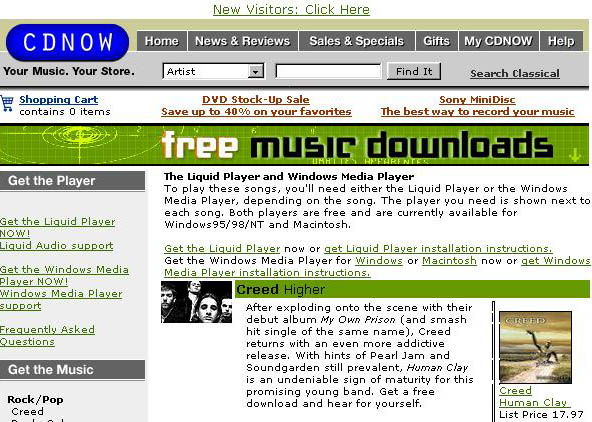
Her words ring true to many speculations as to how the music industry will find alternative ways to generate sales, after national record sales have plummeted since 2001. Especially with the emergence of illegal downloads, streaming music (like Myspace), peer to peer and CD ripping, consumers are having a hard time shelling out cash for music when it is available to them for free. Despite threats and lawsuits, there is no foolproof way to cease digital downloads. Many are speculating to adopt the model of allowing free digital downloads, as a means of free goods, advertisement of the band and incentive to spark further interest in an artist to the point where the consumer may be impassioned to purchase an album, buy merchandise, and pay for concert admission.

Given, Sharon Osbourne has announced that tickets to Ozzfest are free; she projects that concert-goers that were willing to spend money on tickets would instead direct that spending money in merchandise during or after a show. This projection may prove to be successful. Sharon understands the target Ozzfest market. The average heavy metal fan is white, male, aged 13-35, middle class and usually has a limited amount of disposable income. However the average heavy metal fan has more loyalty than most fans in other genres. Loyalty in this sense, is willingness to support a band through merchandise, incentive to see a band live when they come to town. Along with the subject of merchandising, metal fans are culturally, the most likely to purchase, wear and use “merch.” These fans have the tendency to habitually wear band t-shirts as daily garb. They are culturally inclined in their genre to pass on/recommend bands to friends, serving as another form of band marketing within its own microcosm. Countless small-time bands will testify to the fact that they hardly make ends meet simply by playing shows, since most venues are pay-to-play. The flesh of show revenues can be found at the Merch booth, where fans will gladly pay $15 for a shirt that cost $5 to make.

Let this be a harbinger for what could lie ahead in the future. We may very well see free shows that raise profit solely through merchandising. We may give away music for free in the future as incentive to pay for concert admission.

In a sense, Sharon Osborne is adapting to the inevitable of the very market she caters to. She gets it. She understands the way metal fans sleep, eat and breathe music. This year’s marketing model for Ozzfest proves to be promising. However, some question its viability to stay true as an enjoyable concert experience.

Many believe that as a result of free admission, Ozzfest will increase its percentage shares from concert vendors (parking, food, merchandise), thus causing higher prices for concert-goers once they enter its festival gates. We could be looking at $10 water bottles, and $40 parking spaces. Skeptics also question the quality of band lineups, since featured bands will not be compensated directly from Ozzfest itself. It seems as is tour sponsors will be taking care of this problem, while lesser known bands must simply be satisfied with a privilege to play a stage without compensation. This was evident in the past MTV reality series “The Road to Ozzfest” where smaller bands seemed happy to take on grueling experiences to make the bill.

As for what lies ahead, Ozzfest is generating hype for this bold endeavor, and seems confident in its new marketing path. I for one will be at the festival gates, July 7th in Los Angeles with wallet in hand to take part.

More can be viewed @

http://www.mtv.com/news/articles/1551725/20070206/osbourne_ozzy.jhtml?rsspartner=rssYahooNewscrawler


http://ozzfest.com/news_2006.html