Call it a curse, call it a blessing…The Digital Age has revolutionized the music business. Suddenly, the floodgates of music have opened up from channels of non-traditional media that we never could have dreamt up.
It’s a beautiful thing to see the playing field of the music business more leveled than it ever was before. Artists are more accessible to potential audiences through the accessibility if the internet. Music, video, and artist information is finally within reach without the dependence of magazines, MTV, or an album sleeve.
It’s a thrill to discover an artist’s songs simply through a few clicks on MySpace Music. How utterly fascinating is it to carry your entire music library in your pocket? I still wonder how I ever managed to carry around my portable CD player and CD cases around school before I had an iPod.
It’s overtly convenient to purchase music through the iTunes online store, rather than a gas-guzzling trip to the local Tower (RIP) or Amoeba record store.
…but where there lies a convenience in accessibility, leads to a grappling of how an entire industry will change along with this new shift. Although the New Music Experience is more comfortable for consumers, heavy hitters in the industry are having a hard time embracing to New Business models that have must be implicated in order to accommodate non-traditional media. Danny Goldberg, Chairman and CEO of Artemis Records has affirmed the general consensus in a PBS interview, here: http://www.pbs.org/wgbh/pages/frontline/shows/music/perfect/internet.html . He remarked, “I don't know about other business, but I think in the entertainment business in general, people who are successful tend to fear change and fear the unknown...In terms of dealing with the Internet, it's been a profound challenge for the music business.”
Record labels are mourning the death of the CD, whilst avenging the demise of sales through the RIAA’s ‘cease and desist’ mailings to the thousands of once-loyal customers. The current state of the business looks as if it is about to end from illegal downloading. But where there is death, new life sprouts from its deathbed.
There are new modes to flourish and proliferate when non-traditional (or new and exciting) forms of media are coming into place. Now, the industry is being taken over by portable MP3
Players (iPod), online music stores (iTunes, SnoCap), video on demand (YouTube), the video game industry, and social networks (MySpace). Ted Cohen, the Senior Vice President of Digital Development & Distribution of EMI Music had stated, "the billions of songs downloaded from the Web monthly has shown that the digital music revolution is well underway...music fans and artists are going to benefit from the new paradigms and new business models that are emerging.”
Before the Digital Age, customers were wary of new bands, and less willing to expose themselves to new artists because of the dependence on radio, limited accessibility to song samples and cost of a CD. This once put artists in a disadvantageous position to have less exposure than today, without the possible springboards of MySpace. Thankfully to MySpace, today, there is less risk to expose oneself to new artists. We are no longer paying to hear a full length song, buying magazines to read an album review, waiting to view artist photos, or relying on MTV to air an artist’s music video.
Everything is smaller, faster, stronger and most importantly, EASIER. In the next five years, everything will have to be easy.
Portable MP3 Players:
Seeing since DRM is already well on its way out of the window, The Music Industry may later on allow file-sharing or DRM free devices for the iPod and Zune. These devices, along with Sim Cards and Micro SD cards (memory chips for MP3’s) may be the sole mechanisms used for playing songs. In fact, people may just get rid of MP3 playing devices altogether, and stick to memory chips, like the Sim or Micro SD card. These chips have already been used to play music in cell phones and audio sound systems for vehicles. Audi and many other car companies have already implicated packages in their cars that can store one or even two cards as music libraries for audio systems. These nickel-sized chips withhold leaps and bounds of memory, are lighter than a quarter, and are fairly priced (even in today’s market). Even more fascinating about these memory chips is that they can be navigated through (like an iPod) audio players (like car audio systems) simply through a display screen and buttons supplied by the device using it. Laptops and computers will have ports for these chip cards so one can easily upload music with it, without the need for a USB wire or firewire cable.
Online Music Stores:
It’s still debatable whether all music will be free in the next 5 years, but The Music Industry may entirely embrace DRM-free music for all songs that they will carry. One could play, rip and burn songs to their hearts content, without the digital stamp that has blessed MP3’s and AAC files for so long. If music may still not be free, it will be marked down even more. Music buying may arrive in the form of subscriptions where users pay a small, monthly fee to download an excessive or unlimited number of songs, at high quality and format. With this, may also bring unlimited downloads of artist videos, interviews and photos through the very same online store. iTunes or other online stores could later on introduce ticket sales and merchandise through the same online store. This way, the user is more likely to have a one-stop shop, in an easy online format.
Video On Demand:
YouTube is and will be the go-to for on demand artist music videos. The mechanism for easy sharing and viewing of footage has only made it more versatile than other online media player. The advent of portable mobile devices has only expanded the many ways the public is able to utilize, watch and share media through YouTube, now that a large portion of these devices can capture and play video. According to YouTube’s Fact Sheet (http://www.youtube.com/t/fact_sheet), “The explosion in consumer devices with video capability is giving users control over the videos they record, watch, and share, and YouTube is dedicated to making their experience as easy and entertaining as possible.” While YouTube is predominantly used for the searching of old episodes of primetime sitcoms, archived television shows, or home movies, YouTube has taken shape into a social networking interface as well. In Time’s best invention of 2006, Lev Grossman wrote, “The way blogs made regular folks into journalists, YouTube makes them into celebrities.” The article can be viewed here: http://www.time.com/time/2006/techguide/bestinventions/inventions/youtube2.html.
Given YouTube’s current buy-out from Google, it is still unclear where the pioneer of easy video on demand may be five years from now. But online video on demand will be used in the future more to display live acts from artists, music videos, and fan testimonials…all at a quicker, easier rate.
Video Games:
The Future of Music book has accounts from experts in the music industry, one of them being Steve Schner. According to Steve Schnur, the Worldwide Executive of Music, for Electronic Arts, he sees this change in the industry before his very eyes, watching business models change. He acknowledges that it is an industry “…at the crossroads. For those of us who left the record business to go into the music business, video games are the new rock 'n' roll. But no matter where this revolution begins or ends, the industry must learn to respect and react to its consumers.” Five years from now, video games may be the last place for artists to receive a huge bulk of revenue from. Video game companies may also create online music stores for video game players to purchase music, solely for use with their video games. Rock Band and Guitar Hero II are planning on implementing this idea in the very near future.
Social Networks:
Some may debate that today’s white-hot flame of Social Network may diminish into a tiny glow in five years. It is indeed possible that these huge networking webs will break up into smaller interest groups, but it leaves out users who choose to be actively cross-banded with everyone and anyone. Naysayers are missing the fact Social Networking sites have almost gifted all of its users with a sense of self-validation. People like to be recognized, acknowledged and adored…The Facebook and MySpace give this self-gratification to most of its users, and lots of its users have grown addicted to it as a result of this. I cannot see how these Social Network addicts are going to be willing to give this up. People are predicting that MySpace will implode on itself, because of its massive size and others say that it is destined to lose touch like Friendster’s fade out. A large number of people rely on MySpace for networking with Facebook-less people and MySpace Music.
Myspace music is indeed destined to carry on within the next five years. This is because of the rebirth of the playlist. Myspace will likely design an interface for its users that allow them to cherry pick songs from different artists and arrange them into a mix or playlist. This playlist will be posted on the user’s profile, most likely titled, “What I’m Listening To Right Now.” The playlist will also double as an alternating music player on a profile page, rather than a single song widget on each profile. This way, users will be able to sift through 2-50 songs that a profile displays in a playlist. It gives more exposure for more artists, to more users, in a smaller amount of time....rather than a single widget player.
Wednesday, April 25, 2007

Sunday, April 15, 2007
Here's another one from our friends at the RIAA

And you thought they would only label us Communists...
Ozzfest: Too Good To Be True?

Now that the hollering about a free Ozzfest has subdued, people start asking questions with suspicion. A free show that thousands once paid a pretty penny to attend is now free of charge? It raised some eyebrows, to say the least. How could such a business model for this epic tour be supported? One tours for two reasons, band promotion and generating revenue. Sharon Osbourne, the shrewd business woman that she is, has her sleeves full of tricks this year. She will never set up a tour without intent of making profit, bank on it, my friends!
People want to know exactly how much it would cost to run a national tour of this sized magnitude. Sharon Osbourne mentioned that band’s salaries were becoming increasingly over-inflated over the years. She once remarked that the band who got their start on Ozzfest, was now demanding well over $100,000 to be included in the tour. Apparently, it was System Of A Down’s price tag that grew to be the last straw in the camel’s back. System of A Down was demanding a reported $325,000 to be included in the Ozzfest gig list. Given , a band does have huge tour expenses over the course of a national tour, for room, board, transportation and crew.
But now, Ozzfest is a whole new ballpark. This year, no matter how popular the band, no matter how good their act, each band was rumored to cough up $100,000 to Ozzfest to be included in the tour. This tour has morphed into the notorious business of the Hollywood music venues: Pay to Play.
After some casual research, the expense figures changed. An anonymous tipper at Century Media, a label who supplies a healthy number of bands for Ozzfest, has confirmed that each band must submit a fee upwards of $75,000 to be included in the tour. In reality, this expense fee could be going to actual tour costs, but there is still no confirmation as to how this fee will be used towards the tour.
The official at Century Media has also remarked that he is unsure if bands can or will recoup from the expenses. He predicted that given, merchandising is also limited and taxed by Ozzfest, it will only cover so many costs. He also mentioned that if anything, Ozzfest’s intention (for bands at least) is to promote their bands. With the high volume of new people coming to see Ozzfest because of it’s cost-free nature, new markets will be exposed. The tour is to generate band hype, from a record label’s point of view.
In addition to how Sharon plans to profit from such a tour, Ozzfest has recently announced that if fans pre-purchase Ozzy Osbourne’s new album which debuts May 22nd, they are automatically given a secret code that allows them to reserve 2 seats for an Ozzfest show of their choice, 4 days in advance of the general public. The web page from Sony, titled “Pre-order Black Rain to get first dibs on FREE tickets to Ozzfest” gives directions as to how to obtain tickets ahead of the rush.
Indeed a sly move on part of the Osbournes, but all the more bold and inventive. Regardless of intention, the Osbournes do deserve credit for trying something new, in order to stay afloat from sinking business models in the past. View the details, here: http://www.sonymusicstore.com/store/catalog/MerchandiseDetails.jsp?merchId=117577&skuId=117583&sms=alt-ozzy
Wednesday, April 4, 2007
Wouldn’t it be nice if both sides of this furious battle between file-sharers and copyright protectors called a truce?

Impossible! It’s a very tough call. Can the RIAA stop the cog of illegal file sharing? Whether you will take a side or not, you cannot stop illegal music downloads. Monthly sales from file sharing exceed what the music industry makes in one whole year! The music industry itself is powerless as a drop in a bucket of water. Should the RIAA and record industry take a wider stance? Should more notices be sent out to IP addresses that commit this crime? Why do people download? For one, CD prices have spiked up since the days of Napster. Labels tried to make up for their profit losses due to P2P by bumping up their Suggested Retail List Prices. Instead of keeping a steady flow of income for the labels, it deterred music fans away from the purchase of an album or single. Why pay for something at a record store when there is another one being looted next door? Everyone has joined the free-for all.
What record labels should have done a long time ago was take EXTENSIVE action against file-sharing networks in the beginning. The lawsuits against Napster were not enough. Record labels should have taken extra measure to banish all servers, including Limewire, which is still in existence today. The plant should have been nipped at the bud.
But the aggressive stance of RIAA isn’t helping their image either. They are not the Superman to the Record labels. Their menacing tactics and excessively punitive measures have made them look like the bad guys, hurting their image and the image of the record labels. They look money hungry, greedy and soul-less in their notice letters and damage claims against college students and dead grandmothers. The RIAA claims to be protecting the rights of the artist, looking out for their best interest and their copyright protections. But where was the RIAA when artists and bands got sucked dry from their very record labels that claimed to be “helping them.” Artists were not making money from their music and artists are not making money from their music now.
There have been countless bands that have flourished by taking a chance to distribute their music at no cost for giving more incentive to listeners to hear their music and possibly become fans. Countless students agree that they became bigger fans of music when they began downloading for free. When they had the opportunity to obtain new music from new bands till their little heart’s content. They are more willing to be curious; they can afford to listen when new music is free.
However, many music fans listen to music and nothing else. There is a chance that downloaders will not spend their saved revenue on merchandise or concert tickets. They can be content off of sole songs. They don’t need a band t-shirt or the experience of a live show. But this is where the music industry will have to downsize
Labels are already downsizing, compounding into smaller groups, and joining forces. This is the nature of the game. What goes up must come down. This is a trough in success for the industry, but until new technology, software or media pops up for music to latch on to as a new mode for flourish, they might have to stick it out until then.
Los Angeles: No Longer the Famed Music Hotbed

The late 70’s ushered in new music movements to the
The 90’s brought the LA Riots, heroin-chic and the birth of West Coast hip-hop ushering in hard hitting rappers like Dr. Dre, TuPac, Eazy-E, Ice-T and Snoop Dogg. The genre is still, if not more successful.
Regardless of bad taste or judgment, one could count on
But this is my concern:
Warner and V2 Step Up With Trying Before Buying.

Perhaps the labels weren’t deaf. Perhaps the labels are increasingly feeling pressured to meet the public’s demands as music sales decrease. Buying music should be like going to Costco or Trader Joe’s. You walk around, browse the aisles, and come across a sample station to taste morsels of curried chicken, seasoned fries or sliced herb sausage in little paper cups. 90% of the time you really enjoy your sample of food, and end up putting a box or two of the food item you had just sampled in your shopping cart, anxious to eat it at home. This concept needs to be applied to music as well. Although iTunes does offer 30-second clips of the music that you are browsing around for, 30-second clips don’t sound like the entire song. You can’t hear the intro, the verses, the solos, etc...iTunes usually features the clip at the choral parts of the song. This poses a problem for music buyers who become reluctant to purchasing music from iTunes based on a 30-second sample. Let’s face it: music buyers need the whole sample…they need to try the entire song/album before they buy it.
Thankfully, according to NMA.co.uk, a news article by Alex Farber, titled, “Warner and V2 to offer 'try before you buy' download service” may be answering our prayers. Warner and V2 records have agreed to use the try before you buy feature on an online service. “Warner Music and V2 have today agreed to take up eListening Post's viral channel as a way to sell more digital downloads.” These guys are way behind in the race. MySpace has been doing just this for years, exposing users and non users to full-length songs of every artist imaginable. MySpace allowed for fast streaming, making its music player champion among windows media player and quicktime. It's speed and accessibility put others to shame and gave listeners more incentive to hear more artists, in more time, creating MORE fans. It's still hard to believe that some labels out there are having a hard time putting up more songs for listeners to enjoy through MySpace, in fears that they might lose money, or give away "too much" of a song. The real problem is that they disadvantage themselves for limiting material on the web and their Myspace profiles. But with eListening Post's viral channel listeners are aloud up to 5 full listens before purchasing a song. Although music fans are able to listen to full clips of music for free on MySpace, its selection of songs is very limited...then again MySpace does not limited the number of times you can play a song! It’s not yet confirmed if the music players for try and buys allow for rewind, pause and forward features, but it’s another step towards a changing industry as DRM is slowly diminishing. The original aim of the service is to spark interest in a song, hopefully causing listeners to pass the songs on to their friend to try it out too.
The article can be viewed at : http://www.nma.co.uk/Articles/32550/Warner+and+V2+to+offer+
Tuesday, April 3, 2007
Will EMI’s DRM Free Frenzy be agent for a Domino Effect?

…Hopefully. So much has been happening in a single year since the age of digital anarchy came along. People are scrambling left and right for answers, and new ways to reform a symbiotic relationship with the record industry. Music Industry Optimists everywhere are blogging about the DRM-free news with high acclaim. Is this it? Will EMI’s removal of digital rights management (DRM) from songs bear good omens? It’s a small step, but a bold step. EMI has a lot of gusto for being the first of the Big labels to step up and change, despite the fact that Warner also verbalized for several years that it did not believe in DRM. Apple’s iTunes store will be the first to feature these DRM free downloads, but Beatles fans need not apply, since the greatest rock n’ roll band has yet to be included in EMI’s catalogue. That is still a sign of hesitation for EMI, since The Beatles catalogue is a huge truckload of money and liability for the label, not to mention a prized possession.
But the freedom to burn comes with a heftier price tag…DRM free downloads must be purchased to the tune of $1.29 per song, rather than plain old $0.99. Along with this, DRM-free files are available in all sorts of formats, including AAC, WMA and MP3. Personally, there are probably 10-20 songs that I would use over and over again in my CD mixes, therefore making it hard to say how consumers will have the burning need to shell out $1.29 for DRM-free music too.
On a jollier note, EMI’s website had this to say:
“EMI Music will continue to employ DRM as appropriate to enable innovative digital models such as subscription services (where users pay a monthly fee for unlimited access to music), super-distribution (allowing fans to share music with their friends) and time-limited downloads (such as those offered by ad-supported services).”
The section about subscription services and super-distribution is entertaining, considering the fact that these two business models offered through labels are quite new. Although these models still feature DRM, they offer windows to how we might get our music from the future. Hopefully subscription services with low monthly fees become a reality for everyone, incorporating the use of super-distribution and the execution of DRM. We hoped to be DRM-free, its only a matter of time until the rest follow suit.
Gizmodo article: http://gizmodo.com/gadgets/home-entertainment/official-emi-to-release-music-drm+free-248836.php
EMI Press Release: http://www.emigroup.com/Press/2007/press18.htm
Guitar Hero II? Pfft, dude we need the whole ROCK BAND!

On RedHerring.com, in an article titled, “EA, MTV Crank Out Rock Band,” Ryan Olson discusses the advent of how“Guitar Hero developer (will) let gamers form virtual music groups.” Imagine the possibilities…Guitar Hero for the entire crew with a dash of World of Warcraft for rockers. “The company on Monday unveiled Rock Band, a new title that lets friends form virtual cover bands, in the same room or over the Internet, that can crank out their favorite tunes.” The concept is relatively cut and dry, despite the fact that the news has only a few developments in exactly how the game will function and interact with a whole group of people. Gaming devices like Nintendo Wii that depend on physical movement and spacial interation are perfect for Rock Band.
The developer Rock Band, also known as “Harmonix is best known for the rock-themed Guitar Hero and Guitar Hero II. Harmonix creates “games that let individual players strum along to popular music tracks. The franchise has become so popular that Viacom-owned music video channel MTV bought the company last year (see MTV Buys Harmonix: $175M).” MTV Program Enterprises Executive Vice President Jeff Yapp is hoping to create a new medium in which people can enjoy the rock music they love, to a degree beyond karaoke and Guitar Hero I & II.
The video game, Rock Band, by speculation, will incorporate a few guitar heros, a drums hero, a vocals hero, and possibly a bassist hero? It is still in question exactly how many and which instruments will be added to Rock Band. But more importantly, especially with relation to this blog, is outpour of record labels who are willingly opening up their catalogues to EA Games. EMI Music, Hollywood Records, Sony BMG Music Entertainment, Universal Music Group, and Warner Music Group’s Rhino Entertainment have already offered masters as part of their contribution for the game. Rock Band uses player devices like XBOX 360 and Play Station 3, which are connected to the internet. With this golden door of opportunity, gamers could be lured into online interfaces that would require digital download purchases for every song that gamers wish to play to along the way. George White, senior vice president of strategy and product development at Warner Music Group sees how labels could be “likely to release additional tunes after the game ships,” offering a whole new business model.
http://entertainment.bodogbeat.com/solo-guitar-hero-to-full-rock-band-16553.html
Sunday, April 1, 2007
Is Gold Entertainment Really The Golden Promise?

Several online sources, including Top40.com, MN1.com, and PR-inside.com seem over optimistic with the launch of the new Gold Entertainment as the torch-bearer for rise of a better and stronger Indie Music Business. Think of it as the Indie Labels on steroids, getting even with the Big 5 (or 4 is it now?). At this point, it’s hard to project to what extent Gold Entertainment will be using its juiced muscles to manipulate the industry for the indies’ benefit. Gold Entertainment Group wants to hit consumers from all sorts of media outlets, including venue, satellite radio, TV and the internet.
Gold Entertainment does get brownie points for being forward thinking, and adapting new technologies to reaching its markets, but the distribution company has yet to show the masses what it could do.
“Gold Entertainment Group Inc. recently took the new direction as an entertainment and distribution company of content for Television, IPTV and the Internet. In short, the company focuses on the music industry, production and distribution of Television shows, utilizing business opportunities offered through broadcast television, cable, digital satellite music services, and Internet downloads.
“Our goal is to offer consumers of the digital music market, the live performance market, and the recorded product market the opportunity to experience professionally performed, expertly produced, efficiently distributed music shows of many genres focusing on emerging talent,” the company stated.
As earlier proposed to a new business model where free music will find revenue through touring and merchandise, Gold Entertainment group plans to launch its own series of venues, dedicated to showcasing up-and coming bands in the indie scene. But will Gold Entertainment be using these venues to their advantage? A lot of people are giving Gold Entertainment high acclaim for boosting indies in their time of need, but how do we know if Gold will be using a Pay-to-Play business for its venues? Can indie bands even make money by playing these venues through Gold if they cannot make ends meat through record sales? Will Gold be taking a cut from merchandise booth sales from bands as profit for showcasing bands? How will audiences respond to new venues? Will they be 21+? There are so many questions that are yet to be answered, yet every other website is heralding Gold Entertainment as the savior of this business. Gold Entertainment sees profit in indies as the Big 5 is being crushed by its own weight. The article can be viewed here: http://www.mn1.com/members/modules.php?name=News&file=article&sid=13635
Gold Entertainment does get brownie points for being forward thinking, and adapting new technologies to reaching its markets, but the distribution company has yet to show the masses what it could do.
“Gold Entertainment Group Inc. recently took the new direction as an entertainment and distribution company of content for Television, IPTV and the Internet. In short, the company focuses on the music industry, production and distribution of Television shows, utilizing business opportunities offered through broadcast television, cable, digital satellite music services, and Internet downloads.
“Our goal is to offer consumers of the digital music market, the live performance market, and the recorded product market the opportunity to experience professionally performed, expertly produced, efficiently distributed music shows of many genres focusing on emerging talent,” the company stated.
As earlier proposed to a new business model where free music will find revenue through touring and merchandise, Gold Entertainment group plans to launch its own series of venues, dedicated to showcasing up-and coming bands in the indie scene. But will Gold Entertainment be using these venues to their advantage? A lot of people are giving Gold Entertainment high acclaim for boosting indies in their time of need, but how do we know if Gold will be using a Pay-to-Play business for its venues? Can indie bands even make money by playing these venues through Gold if they cannot make ends meat through record sales? Will Gold be taking a cut from merchandise booth sales from bands as profit for showcasing bands? How will audiences respond to new venues? Will they be 21+? There are so many questions that are yet to be answered, yet every other website is heralding Gold Entertainment as the savior of this business. Gold Entertainment sees profit in indies as the Big 5 is being crushed by its own weight. The article can be viewed here: http://www.mn1.com/members/modules.php?name=News&file=article&sid=13635
Apple Supports a New Business model for the Record Industry

In an article titled, “Apple Backs Music Industry Format” from NewsMax.com this week, Apple is exploring a new way to back the “album format” method of music buying- online. The online music service, iTunes, will offer credit to users for every song that they already own from albums that can be found on iTunes. So, a user gets a $0.99 credit to purchasing the album that the matching song they own.
The article states: “Apple said on Thursday iTunes is introducing a "Complete My Album" service that offers customers who want to turn individual tracks into an album a 99-cent credit for every song they have already purchased from the album.
For example, if a customer had bought three 99-cent singles and decides to download the entire album with a listed price of $9.99, the customer would only have to pay $7.02.” Although previous posts in this blog have supported new methods to revenue, it does customize demand for this specialized sector in the record industry. Perhaps Apple is trying to appease the labels after his DRM-free public announcement? The model is advantageous to both iTunes users looking to complete collections, and the business model that most labels are desperately trying to cling to as album sales continue to drop.
It keeps consumers from buying the same song twice, if they do choose to move to buying an entire album, but do not wish to spend the $9.99. The new model seems to be something Apple should have introduced a long time ago, but didn’t feel pressured to do so until album sales continued to plummet. Is it the last gasp of the album? No. But it does demonstrate how some music services are feeling the heat of low sales, bending to pressure to lower price, even lower than $9.99.
If anything, it could serve as a domino effect for other music services to provide affordable ways to buy music, even it will eventually be free in the future.
The article can be viewed here: http://www.newsmax.com/archives/articles/2007/3/30/140141.shtml?s=te
Monday, March 26, 2007
Free File-Sharing or Bust: We’re Already on that Road

Professor Del Colliano at USC Thornton School of Music has often mentioned to “embrace the inevitable” and be fluid to change in order swim with the wave, rather than be drowned by it. It must be applied to music industry business models today in order for labels (what’s left of them) to remain afloat. Labels refuse to bend to the whim of their lost consumers who have resorted to illegal file sharing, causing hundreds of millions of dollars in lost revenue. But can embracing the change resuscitate the flat-lining pulse of this business?
It’s worth a shot. The record industry is so far into its own mess, that it has no where to go but up. In the medical field, people are being cured with the very same viruses that have riddled their bodies with sickness. This can be done with the record industry and file-sharing. Why not use file-sharing as a friend rather than foe, exploit artist’s music as a means of marketing, public buzz, and taste-testing to whet the appetite of the consumer. The average consumer is no longer enticed by a mere band photo and artist logo in Rolling Stone or Spin. Consumers are jaded and convinced that it’s all the same. They need to be exposed to the band with more than just one sense. This in no way means that music consumers solely need to hear new music on the radio, because radio is another horse that’s been already beaten to death. Offer free, high quality downloads to consumers! Revolver Magazine has already embraced this model, exposing its readers to 6-7 free, legitimate artist downloads upon purchase of each monthly issue of its magazine (a download code is provided to regulate traffic).
iTunes itself offers free weekly music downloads (one weekly per user), exposing artists to millions of consumers. Although many attack the idea of free downloads, because it poses a disadvantage to the artist, but critics should chew on this: out of all the artists out there, how many are already making a comfortable living by selling their music? The answer: probably a handful. In today’s sea of pre-packaged crap from labels where rappers have pre-negotiated “bling accounts” and rockers have an endless supply of tight pants, new artists are hungry for a shot at exposure.
Three years ago, Techdirt released an article for its readers to build upon a theory or business model in which record labels would embrace file-sharing rather than fight it. The article “A Business Model Involving Free File Sharing” (http://www.techdirt.com/articles/20030912/1032238.shtml ), was widely acclaimed and widely despised. The staff at techdirt chose a model which relied upon tour and merchandise revenue, even suggesting that labels be formed into “fan clubs” where users pay yearly membership fees to have all-access to artists, media, music and the whole lot. A user suggested that
“The bands are now making money from (a) concerts (b) fans who are "subscribed" to their service and (c) still from selling tangible merchandise. Fans get to directly support the bands they like. The actual music can be enjoyed by a wider audience. Digital music files are seen as promotions, and thus a band is more likely to get a wider audience, meaning more people joining their fan club. No, not everyone will join, but so what? Not everyone buys CDs now.”
A Desperate Need for Shifts in the Record Industry

We’ve all heard it. The music industry is dying, sinking, disintegrating, whatever. Executives should no longer look at CD sales as the lifeblood of this industry. There is disregard for copyright with the advent of file sharing and illegal downloading, yet the bigheads at the label refuse to change their business models in order to give way to a new channel of revenue. We find consumers downloading digital singles rather than the purchase of a tangible album in a jewel case from their local music stores (which are already on the brink of extinction). Why hold on to the life raft that cannot float?
The
In ties with the New York Times article, Techdirt.com offered a plausible business model in an article here “If Albums Are Dead, Why Not Offer Playlists?” ( http://www.techdirt.com/articles/20070326/005758.shtml ), suggesting Playlists. Why? Because with the rise of the iPod, MySpace playlists, iTunes, and file-sharing there has always been: The Playlist. We use playlists to entertain parties, burn CD’s and keep us interested on-the-go. It seems highly logical since most consumers now lack the attention span to listen to albums for even 3 songs through. We prefer CD mixes over the album when in the car. We are entertained by the house DJ with his cherry-picked selection of singles and remixes. ITunes offers playlists for sale, made by iTunes staffers and users alike. Every playlist’s price is marked proportionate to the number/popularity of songs combined, and sell moderately well if arranged well. The proof is in the “Now, That’s What I Call Music!” pudding, arranging a mix of the season’s/year’s top singles arranged in an album form. It seems as if the bigheads have their work cut out for them, if they choose to shift. What do you think?
Thursday, March 1, 2007

Gizmodo passionately boycotts the RIAA with a manifesto
Gizmodo, one of the most popular technology and gadget sites on the interment, publicly bans the RIAA in a manifesto, uncovering the wrongdoings of an association who has claimed to be wronged itself. This is one of the first times any media agent has openly called for action against the RIAA. An excerpt from the maifesto (which can viewed here: http://gizmodo.com/gadgets/home-entertainment/gizmodos-antiriaa-manifesto-239512.php ) features two distinct muckraker-esque articles which have “hit the nail on the head” in regards to sentiments on the music industry in its entirety. This is the except from the article itself which has featured the two pieces from Courtney Love and Steve Albini.
“Rescuing Artists From Those Claiming to Support ThemAs we're a technology website, we're most in touch with the RIAA's actions in response to music downloading as opposed to their history of poor artist management and unfair retail tactics. However, it's worth noting that issues such as the underpayment of artists and album price-fixing are quite serious and should be considered as good a reason as any to keep your money from going to their pockets. Two articles worth reading to study up on how major labels screw over the artists they claim to represent are Courtney Love's speech to the Digital Hollywood online entertainment conference and The Problem with Music by Steve Albini. Both are written by artists who have first-hand knowledge of just how badly major labels take advantage of musicians, and both are guaranteed to change how you view the music industry.”
In these articles, Love and Albini roughly calculate how much of money made from an album is directed towards an artist and how much of it goes to the record label. The article from Steve Albini is highly acclaimed, offering insight to how funds for a band are spliced apart, leaving virtually nothing for each of the band members, even though the band itself sold 3 million copies of their album. The article definitely raises eyebrows as to how much a labels are looking out for the welfare of their dancing monkeys/artists. Exactly how well do labels take care of their artists? If you take away superstar artists and calculate income from an average joe/indie band, are they better off working at a 7 eleven? Is it the band's fault that it never recoups? Hopefully both the record labels and the RIAA will listen to the public outcry for change in the music industry. Things need to change.
“Rescuing Artists From Those Claiming to Support ThemAs we're a technology website, we're most in touch with the RIAA's actions in response to music downloading as opposed to their history of poor artist management and unfair retail tactics. However, it's worth noting that issues such as the underpayment of artists and album price-fixing are quite serious and should be considered as good a reason as any to keep your money from going to their pockets. Two articles worth reading to study up on how major labels screw over the artists they claim to represent are Courtney Love's speech to the Digital Hollywood online entertainment conference and The Problem with Music by Steve Albini. Both are written by artists who have first-hand knowledge of just how badly major labels take advantage of musicians, and both are guaranteed to change how you view the music industry.”
In these articles, Love and Albini roughly calculate how much of money made from an album is directed towards an artist and how much of it goes to the record label. The article from Steve Albini is highly acclaimed, offering insight to how funds for a band are spliced apart, leaving virtually nothing for each of the band members, even though the band itself sold 3 million copies of their album. The article definitely raises eyebrows as to how much a labels are looking out for the welfare of their dancing monkeys/artists. Exactly how well do labels take care of their artists? If you take away superstar artists and calculate income from an average joe/indie band, are they better off working at a 7 eleven? Is it the band's fault that it never recoups? Hopefully both the record labels and the RIAA will listen to the public outcry for change in the music industry. Things need to change.
UK TOP 40 NOW INCLUDES DIGITAL DOWNLOADS

“Essex rock band Koopa could become the first unsigned group to land a UK top 40 hit thanks to new chart rules”
Until 1 January, bands and artists were only allowed to release singles on CD or one alternative physical embodiment - which would only mean that an artist required a record deal - to be qualified to enter the charts.
However the rules changed, effective January 1st, bands who sold songs on their own through official downloading services, like iTunes, are eligible to enter the charts. The band, Koopa, which entered at #17, made their place in the charts through internet/mobile downloads. Most of the downloads were made via mobile phone, usually coming from teenagers the bulk of their fan base. Mobile downloads allow new markets, like teenagers to have the power to purchase music, since a lot of them “don’t have credit cards.”
“Once again, the music industry is rapidly evolving toward the self-generated digital market”
Although the news is coming from the United Kingdom, it should serve as a harbinger to the music industry in the States. The news shows that music industries in other countries are changing standards and rules to keep up with an evolving industry. It gives artists power to help themselves, without a strong arm of a record label. However, even if it allows bands to further their careers without a label, it may even help bands get signed. It will show labels what kind of music they should start supporting, as a means of scouting and interest.
The article was written by Ian Youngs from the Entertainment reporter, BBC News website. It can be views here: news.bbc.co.uk/2/hi/entertainment/6248535.stm
Monday, February 19, 2007
Piracy Costing L.A. Billions: Boo-Hoo.
According to a new study by the Los Angeles Economic Development Corporation(LAEDC), the city of Los Angeles has lost $483 million in tax revenues just in one year, 2005, derived from the $5.2 billion dollar loss from LA companies, as a result of piracy hurting the music industry. Obviously downsized profits from the industry have indirectly downsized the city tax obtained from these industry profits. One can only imagine that the downsized tax flow is a result of the entertainment industry lessened profits and consolidations. “(LAEDC) identifies measurable losses in local revenues, jobs, wages and taxes due to piracy. The report describes the economic impact of piracy across nine different sectors of the Los Angeles economy and finds the entertainment industries - motion pictures, music, and related industries - to be hit hardest.” Which businesses haven’t experienced some sort of loss of revenue, jobs and wages? Its difficult to donate sympathy, because an industry this innovative will surely find a means of recouping losses in the future.With all due respect, piracy is indeed abomination to the Los Angeles Entertainment Industry and the Los Angeles Economic Development Corporation, but how can the industry follow this business model for so long? It was only a matter of time until a technological development would come along and revolutionize the way music, movies and such were obtained and profited from.
Los Angeles loses millions tax dollars yearly throughout many business and development endeavors but it also profits from thousands of others.
Maybe the “Inter-Governmental Anti-Counterfeit Task Force” shouldn’t start putting on their leotards and good-guy capes on yet. Why put millions of dollars in a new Super Task Force when the Los Angeles Police Department’s been doing the same job all along? Remember Santee Alley and the million-dollar counterfeit handbag industry? We already have the exact same system in place in Los Angeles, why make a new one for the Entertainment Industry?
The article can be viewed at:
http://www.billboard.biz/bbbiz/content_display/industry/e3id6f82030275ca4402900cf3779263599
Los Angeles loses millions tax dollars yearly throughout many business and development endeavors but it also profits from thousands of others.
Maybe the “Inter-Governmental Anti-Counterfeit Task Force” shouldn’t start putting on their leotards and good-guy capes on yet. Why put millions of dollars in a new Super Task Force when the Los Angeles Police Department’s been doing the same job all along? Remember Santee Alley and the million-dollar counterfeit handbag industry? We already have the exact same system in place in Los Angeles, why make a new one for the Entertainment Industry?
The article can be viewed at:
http://www.billboard.biz/bbbiz/content_display/industry/e3id6f82030275ca4402900cf3779263599
Wednesday, February 14, 2007
Thanks to the Germans, Maybe the RIAA Should Sue Themselves

A recent story from Ars Technica illustrates a study in the Journal of Political Economy by Felix Oberholzer-Gee and Koleman Strumpf has discovered that “illegal music downloads have had no noticeable effects on the sale of music, contrary to the claims of the recording industry.” The idea seems a bit far fetched, considering how many internet savvy computer users have confessed to file-sharing and illegal downloading. The German study surveyed P2P servers containing sales from SoundScan. The survey then tracks the millions of songs downloaded on over 600 albums that were sold during th same time period. One may ask how a German study can speak for US Sales. Out of every 6 downloads in the US, 1-2 of them come from Germany. The notorious sales slump of CD sales during the last 6 years is not really victim to digital downloading.
“Using detailed records of transfers of digital music files, we find that file sharing has had no statistically significant effect on purchases of the average album in our sample," the study reports. "Even our most negative point estimate implies that a one-standard-deviation increase in file sharing reduces an album's weekly sales by a mere 368 copies, an effect that is too small to be statistically distinguishable from zero.”
The survey theorizes that the slump can be in fact linked to other causes. The recording industry seems to only look at CD’s shipped, rather than CD’s sold, which could stain SoundScan’s tallying. The record stores carry less CD’s, due in part to a shift in inventory: DVD’s. Much of the public’s disposable inventory is likely to b spent on a DVD rather than a CD. Best Buy discovered this correlation when they saw a boom in DVD sales and a slump in their CD sales.
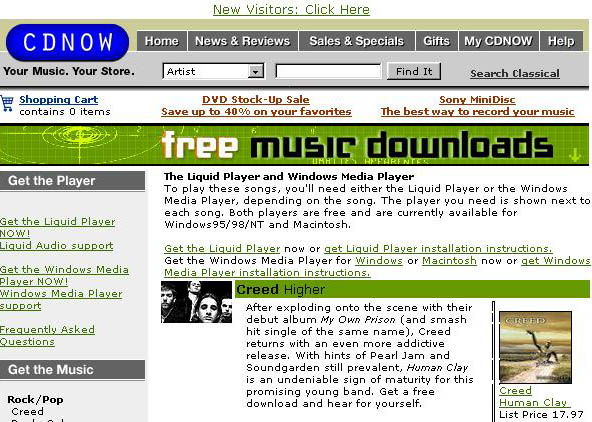
But what the article fails to address is the fact the record industry is not healing its own wounds, rather hurting itself further by bumping up CD prices. Average Suggested Retail List Price is 17.98. Almost a whopping $20, which most consumers would likely prefer to spend on a DVD. Perhaps the RIAA should start pointing their fingers somewhere else and stop filing so many petty lawsuits.
The article can be viewed at:
http://arstechnica.com/news.ars/post/20070212-8813.html
Wednesday, February 7, 2007
OZZFEST 2007: Brilliant or Ludicrous Marketing Scheme?

“…we just thought we can't keep on raising ticket prices because there is not that much money out there anymore. Hey, kids can go online and download music, why not go to a show for free too?”
Her words ring true to many speculations as to how the music industry will find alternative ways to generate sales, after national record sales have plummeted since 2001. Especially with the emergence of illegal downloads, streaming music (like Myspace), peer to peer and CD ripping, consumers are having a hard time shelling out cash for music when it is available to them for free. Despite threats and lawsuits, there is no foolproof way to cease digital downloads. Many are speculating to adopt the model of allowing free digital downloads, as a means of free goods, advertisement of the band and incentive to spark further interest in an artist to the point where the consumer may be impassioned to purchase an album, buy merchandise, and pay for concert admission.
Given, Sharon Osbourne has announced that tickets to Ozzfest are free; she projects that concert-goers that were willing to spend money on tickets would instead direct that spending money in merchandise during or after a show. This projection may prove to be successful.
Let this be a harbinger for what could lie ahead in the future. We may very well see free shows that raise profit solely through merchandising. We may give away music for free in the future as incentive to pay for concert admission.
In a sense, Sharon Osborne is adapting to the inevitable of the very market she caters to. She gets it. She understands the way metal fans sleep, eat and breathe music. This year’s marketing model for Ozzfest proves to be promising. However, some question its viability to stay true as an enjoyable concert experience.
Many believe that as a result of free admission, Ozzfest will increase its percentage shares from concert vendors (parking, food, merchandise), thus causing higher prices for concert-goers once they enter its festival gates. We could be looking at $10 water bottles, and $40 parking spaces. Skeptics also question the quality of band lineups, since featured bands will not be compensated directly from Ozzfest itself. It seems as is tour sponsors will be taking care of this problem, while lesser known bands must simply be satisfied with a privilege to play a stage without compensation. This was evident in the past MTV reality series “The Road to Ozzfest” where smaller bands seemed happy to take on grueling experiences to make the bill.
As for what lies ahead, Ozzfest is generating hype for this bold endeavor, and seems confident in its new marketing path. I for one will be at the festival gates, July 7th in
http://www.mtv.com/news/articles/1551725/20070206/osbourne_ozzy.jhtml?rsspartner=rssYahooNewscrawler
Subscribe to:
Posts (Atom)
